
One of the most interesting aspects of recruitment is that the role an organisation thinks it needs is not always the role it actually needs.
Employers often begin the conversation with a title. They need an administrator, a coordinator, a customer service representative, or perhaps a bookkeeper. The title provides a starting point, but it rarely tells the full story. Once we begin asking questions about the business, the customers, the workflows, and the future direction of the organisation, the role often becomes much more nuanced.
That was certainly the case in a recent engagement with a client in the hospitality industry. At first glance, the requirement appeared relatively straightforward. The business was seeking support with administration, customer communication, bookings, invoicing, and general coordination. However, as we explored the role in greater detail, it became clear that the organisation was not simply looking for someone to complete tasks. They were looking for someone who could help carry a growing portion of the business.
Like many entrepreneurs, the business owner had spent years building relationships, developing systems, solving problems, and creating a customer experience that reflected their personal standards. Much of the organisation’s success was tied to those efforts. As the business continued to grow, the challenge was no longer finding work. The challenge was finding someone who could step into an increasingly complex environment and contribute meaningfully to it.
This is where recruitment becomes more art than science.
A job description can list responsibilities. It can identify qualifications, software requirements, and years of experience. What it cannot easily capture is the combination of judgement, initiative, attention to detail, adaptability, and ownership that often separates a successful employee from an average one.
Many employers have experienced the frustration of hiring someone whose credentials looked excellent on paper only to discover that the individual struggled once they entered the role. The issue is not always a lack of knowledge or technical ability. More often, the challenge lies in the behavioural aspects of work. Some people naturally anticipate problems before they arise. Others require constant direction. Some communicate proactively and take ownership of outcomes. Others wait to be told what to do next.
For organisations operating in fast-moving sectors such as hospitality, tourism, customer service, and professional services, these differences can have a significant impact on performance. A missed follow-up, a delayed response, an overlooked detail, or a poorly managed customer interaction can affect not only an individual transaction but also the reputation of the business itself.
This is particularly true in small and growing organisations where employees are often required to wear multiple hats. The reality is that many modern roles no longer fit neatly into traditional categories. Someone may spend part of their day communicating with customers, another part coordinating vendors or suppliers, and another maintaining records or supporting operational activities. They may need to move comfortably between technology platforms, respond to changing priorities, and make sound decisions without constant supervision.
In these environments, employers are often recruiting for capability rather than a specific job title. They are looking for individuals who can learn quickly, think independently, communicate effectively, and contribute positively to the organisation as it evolves.
At Paperclip, this is why we spend significant time understanding the business before launching a recruitment exercise. We are interested not only in the tasks a person will perform, but also in the environment in which they will operate. We want to understand what success looks like, what challenges the organisation is trying to solve, and what behaviours are most likely to contribute to long-term performance.
These conversations frequently reveal that the most important qualities are not technical at all. Technical skills can often be taught. It is far more difficult to teach reliability, professionalism, initiative, accountability, and a genuine commitment to delivering excellent service.
As businesses continue to adapt to changing customer expectations, new technologies, and evolving workforce dynamics, recruitment is becoming less about filling vacancies and more about building organisational capacity. The right hire can strengthen systems, improve customer experiences, increase operational effectiveness, and create the foundation for future growth.
That is why recruitment should never be viewed as simply finding someone to occupy a seat. At its best, recruitment is an investment in the future of the organisation.
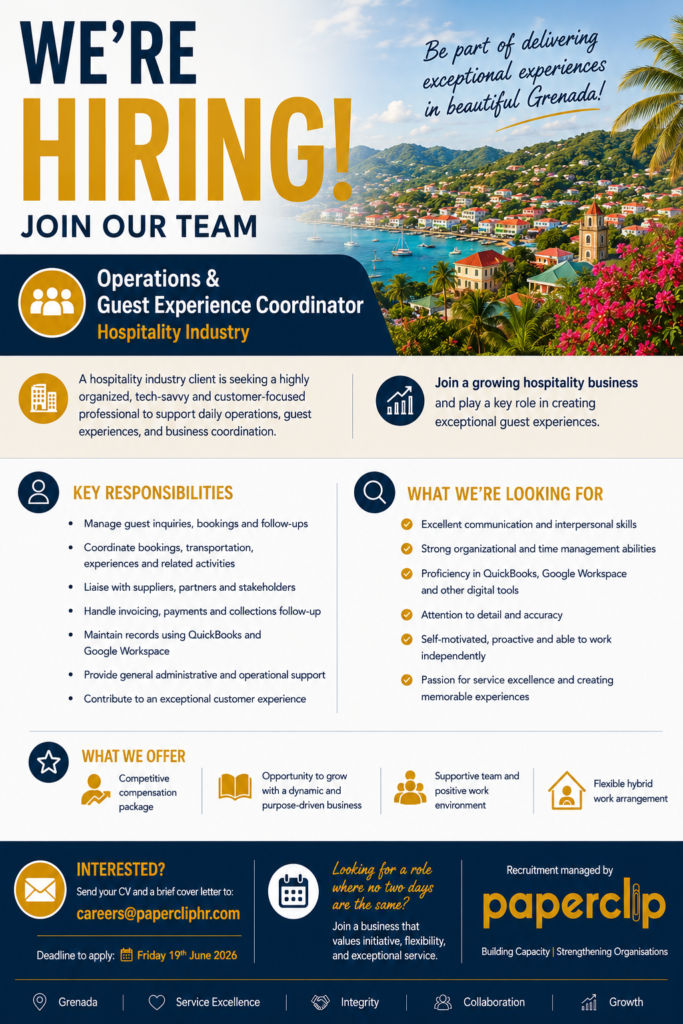
Paperclip is currently recruiting on behalf of a client in the hospitality industry for an Operations & Guest Experience Coordinator. This opportunity is ideal for someone who enjoys working with people, solving problems, coordinating multiple moving parts, and contributing to exceptional customer experiences.
Interested candidates are invited to submit their applications to careers@papercliphr.com by Friday, 19 June 2026.
Building Capacity | Strengthening Organisations